Last autumn, JUB Holland’s bulb planting machine moved steadily along Eliot footpath at the University of Kent.
Within just a few hours, 60,000 bulbs were planted beneath the grass along one of the busiest walking routes on the campus.
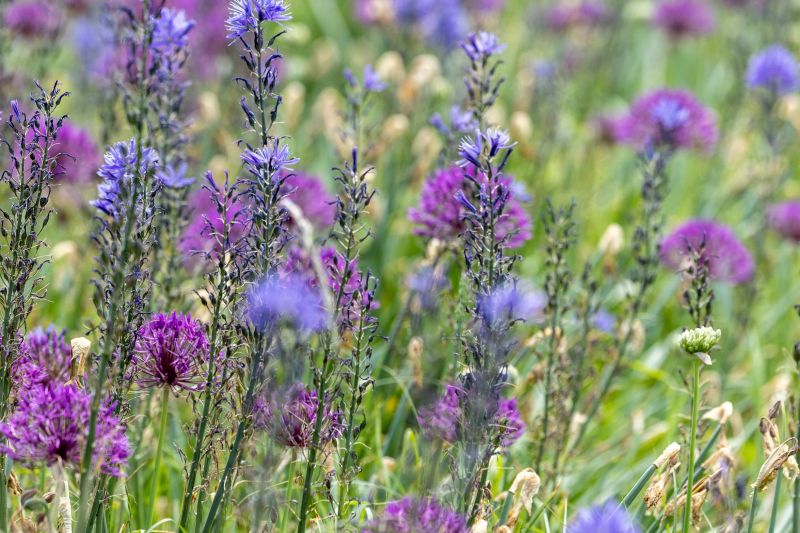
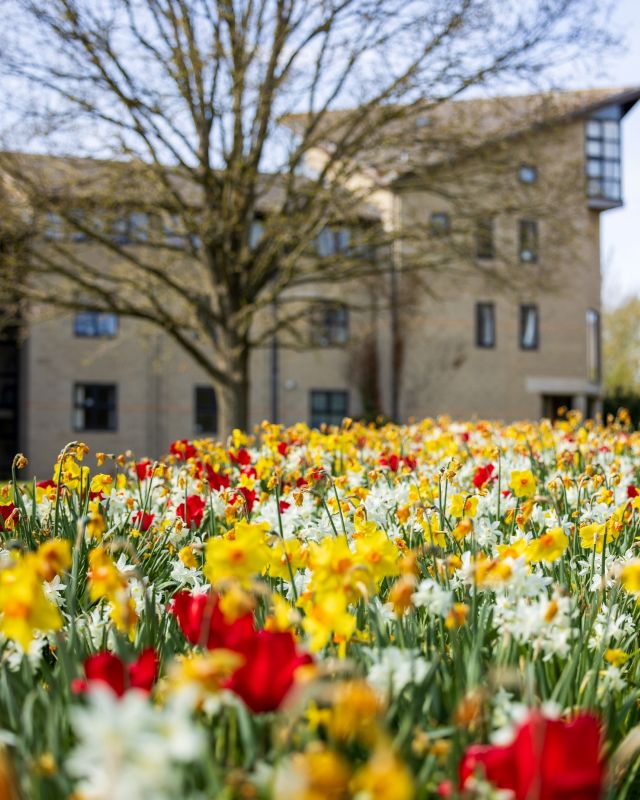
Early spring, the transformation became visible. Daffodils were first to emerge, followed by tulips, camassias and alliums. And now, as summer gives way to autumn and the campus community returns for the new academic year, crocus and colchicum bring the flowering season back to life.
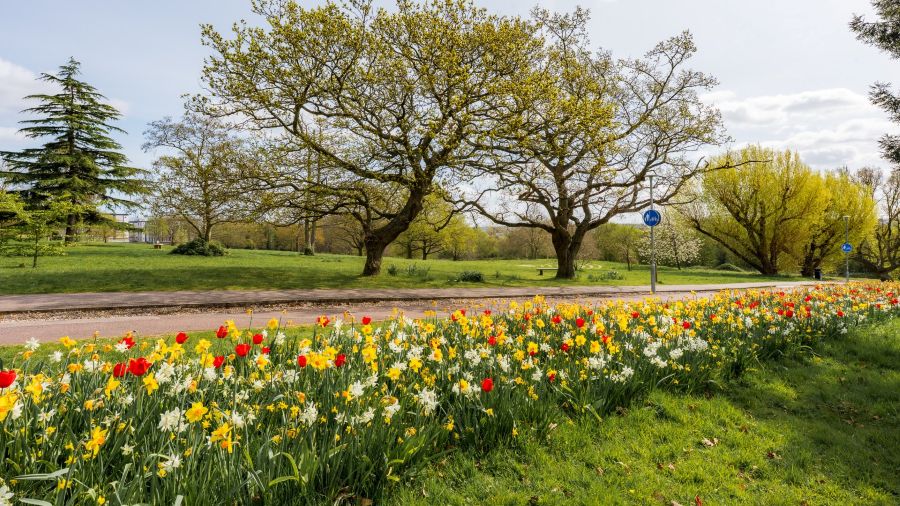
The planting forms part of The River, a two-kilometre trail created for the University’s 60th anniversary and celebrating six decades of growth across its distinctive parkland campus. The bulb scheme adds a new seasonal dimension to that story – one designed to deliver much more than a burst of spring colour. At an early stage of the project, the scheme was visualised using JUB Holland’s FlowerDesigner App, helping to explore how the planting would work along Eliot footpath and how the flowering sequence would unfold through the seasons.
Flowering beyond spring
JUB Holland’s Kent Mixture provided a fitting starting point for the project – not least because of its name. Its succession of spring-flowering bulbs already creates a long and varied display from March to June. For the University of Kent, the mixture was taken a step further with the addition of autumn-flowering crocus and colchicum, extending both the flowering season and the visual impact well beyond spring – all mechanically planted in one go.
The colour palette shifts with it: from fresh whites, yellows and reds early in the season to cooler purples and blues towards summer, before soft lilac and white return in autumn. Rather than one concentrated display, the planting creates a sequence of distinctly different seasonal scenes along the route.
For the hundreds of students, staff and visitors using Eliot footpath every day, that means a landscape that continues to change and surprise. For pollinators, it means a succession of flowering plants at key points in the season, including periods when other food sources are scarce.
Emily Mason, Sustainability Officer (Biodiversity and Natural Spaces), University of Kent: “The River is about celebrating the plant communities that make our campus distinctive. The bulb planting brings a strong seasonal experience to one of our busiest routes and helps us extend the flowering opportunities available for pollinators across the year.”
The bulbs sit alongside ancient woodland, grassland meadows, orchards and ornamental trees, adding a new flowering element to an already varied network of habitats.
A mixture shaped by the site
Successful bulb planting begins with understanding the landscape it has to work in. For JUB Holland, species selection goes far beyond colour. Soil conditions, grass growth, flowering period, long-term performance and the mowing regime all influence the final mixture. At Kent, the brief combined three clear ambitions: a long flowering season, lasting value for pollinators and a planting that works with less intensive grass management.
Job van Eeden, JUB Holland UK: “The strongest bulb schemes start with the site. We look at when colour is needed, how the planting can support pollinators, which bulbs will perform well in grass and how the area needs to be managed afterwards. That is what turns a bulb mixture into a landscape solution.”
The autumn-flowering species are an important part of that thinking. Rather than allowing the display to finish in June, they bring renewed colour and flowering later in the year, when fewer plants may be in bloom elsewhere.
Managing with the flowering cycle
The success of a naturalising bulb scheme depends as much on what happens after flowering as on what is planted. Once the main spring display has finished, foliage needs time to die back naturally and return energy to the bulbs for the following season. At Kent, the current guidance is to allow around eight weeks, depending on growing conditions.
That creates a defined mowing window in high summer. Once the spring bulbs have completed their cycle, the grass can be cut before the first shoots of the autumn-flowering bulbs appear. The approach fits naturally with Kent’s wider grassland management, including No Mow May and its new Let it Bloom June trial.
Lee Ballard, Landscape, Grounds and Biodiversity Manager, University of Kent: “The timing of this flower bulb mixture gives us a clear way to manage the area through the season. It supports the planting, works with our wider biodiversity goals and still allows us to keep the campus looking cared for and purposeful.”
From flowering to biodiversity
The ecological life of Kent’s Canterbury campus is actively monitored. Its annual BioBlitz brings together students, scientists, wildlife organisations and the local community to record the species found across the grounds.
Ongoing biodiversity monitoring has now brought the campus total to 1,800 recorded species, placing Kent second among participating UK university campuses for recorded species diversity. These observations provide a valuable evidence base, helping the University track how changes in landscape management are reflected in the wildlife found across the campus.
A particularly interesting discovery came on 1 June, when students from Kent’s Durrell Institute of Conservation and Ecology recorded a Fiery Clearwing Moth (Pyropteron chrysidiformis) among the grass and alliums – a first recorded sighting for the campus. The rare and protected species has traditionally been associated with coastal habitats in Kent, but recent monitoring shows that its distribution is shifting further inland. Its appearance on campus provides an intriguing new data point in Kent’s ongoing biodiversity monitoring. Continued recording will help reveal whether this was an isolated sighting or part of a wider change in how the species is using the campus landscape.
Next spring starts this autumn
Kent was the first of many UK locations mechanically planted by JUB Holland during the 2025 planting season. Its first full flowering year is also a reminder of an important principle: the best spring landscapes are planned well before spring arrives.
Early autumn planning gives landscape managers a wider choice of species and mixtures, more opportunity to match planting to site conditions and maintenance, and greater flexibility when scheduling installation. Planting within the right autumn window (from mid-September to mid-December) also gives perennial bulbs the opportunity to establish before winter and perform strongly in the seasons ahead.
So where could the flowering season be stretched further in the landscape already under your care? Where could grass deliver more colour, more ecological value and a more purposeful management regime? With the right bulbs, in the right place, under the right management, an ordinary stretch of grass can become one of the hardest-working parts of the landscape.