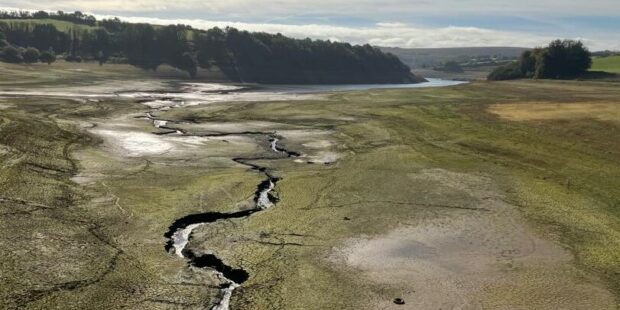
Most of England’s reservoirs are now classed as notably or exceptionally low after another dry month and the government is working with water companies to ensure supplies are protected.
At this time of year, the Environment Agency would expect England’s overall reservoir storage to be almost three-quarters (74.3%) full.
But because of this year’s drought most are less than half full, with concerns for Ardingly (West Sussex) and Wimbleball (Somerset) that are 23% and 21% full respectively.
The updated statistics come after Prime Minister Andy Burnham and Environment Secretary Dame Angela Eagle both made clear this week that water is a priority area for the Government.
For the essentials of life, like water, the public interest should be the primary consideration - and this summer’s drought has underlined that need.
On top of persistent action through the summer to coordinate across the water sector through weekly National Drought Group meetings, there will be wholesale reform of the industry through the strengthened Water Bill. More details will be set out in the coming months on the Government’s plans for water.
The Government and the Environment Agency continue to scrutinise water company actions and ensure they are adhering to their statutory drought plans to conserve supplies and support communities.
As well as enhanced monitoring and more checks on abstractors, the EA is quickly processing drought permit applications to allow water companies to reduce the amount of water they must provide into local rivers.
This means public water supplies are better protected, while also balancing the needs of the environment and local wildlife.
South East Water is set to apply to the Government today (Friday) for a non-essential use ban (NEUB) that would leave more water available for households to prevent the need for additional measures.
Water Minister Emma Hardy said: “This is further evidence that fundamental reform is needed to make the water sector deliver for the public interest.
“We know this year’s record dry spring and successive summer heatwaves have really stretched water resources, but any further disruption to customer supplies would be entirely unacceptable.
“Water companies must urgently take every possible step to conserve what remains, quickly fix leaks, reduce demand, and progress any contingency plans they need for the weeks ahead.
“Our strengthened Water Bill will start a decade-long journey to a very different water system, including nine new major reservoirs to secure supplies.”
September is the sixth month this year that has recorded less than average rainfall, averaging 65% across the country.
However, there are significant regional differences with the drought-hit areas of England again seeing the least amount of rain. The east and south east saw 52% and 57% respectively. Central England saw 59% and the south west 69%.
The cooler temperatures have seen demand for water reduce but we are still using more than expected for this time of year – putting reservoirs and public supplies under strain.
Depending on rainfall and demand by consumers and businesses, reservoir storage is set to continue to decline throughout the rest of the year without major interventions – such as NEUBs.
Soils are still very dry and the Environment Agency recently warned that we need 120% of average rainfall over the coming seven months for the entire country to be out of drought by next spring.
El Niño is set to put the UK at a slightly greater risk of a wet, stormy autumn but drought pressures will persist in some areas. Climate change means we are seeing an increase in both drought and flooding, and it is possible to have them simultaneously.
Yesterday’s National Drought Group saw the EA announce two key changes to the way abstraction licences work to help farmers.
The moves follow the recent £65million funding boost announced by Mr Burnham over the summer.
The first change allows farmers to start filling up their water storage reservoirs from yesterday (instead of November 1st), making sure they are prepared for continuous drought conditions. To protect the environment, this change will not apply to river catchments that are classed as principal salmon rivers to help fish stocks recover or those where S57 restrictions are in place.
The second change makes it simpler for farmers to apply for longer-term abstraction licences.
Environment Agency Chief Executive Philip Duffy, who chaired yesterday’s National Drought Group meeting, said: “As the national drought group heard this week, continued below average rainfall means we all need to use water wisely. The drought is far from over.
“The Government and regulators are working closely with the water industry to manage water reserves carefully and have taken a number of steps to help.
“But we also need to support agriculture, and we have implemented a number of steps to help farmers boost their resilience whilst protecting the environment.”
Other action includes:
- £100million to strengthen the country’s capacity to respond to extreme weather and wildfires.
- Continued water company work on resilience, including nine new reservoirs by 2050 as well as desalination plants and multiple water transfers to help secure future supplies.
- Changes in the Planning and Infrastructure Act to enable non-water sector companies to build reservoirs that are automatically considered as nationally significant infrastructure projects, which will speed up the approvals for new reservoirs.
- Continued work on nature-based solutions, such as restoring peatlands, creating more wetlands and planting more trees, to prevent flooding and hold more water in drought.
- Continued cross-government work on resilience to extreme weather, such as droughts, flooding, and wildfires.
- The National Drought Group is now meeting weekly to monitor the situation and coordinate action as part of the heightened incident response.
- The Environment Agency is working on 10 Drought Permit applications, including recently granting South East Water a permit to help support Ardingly Reservoir.