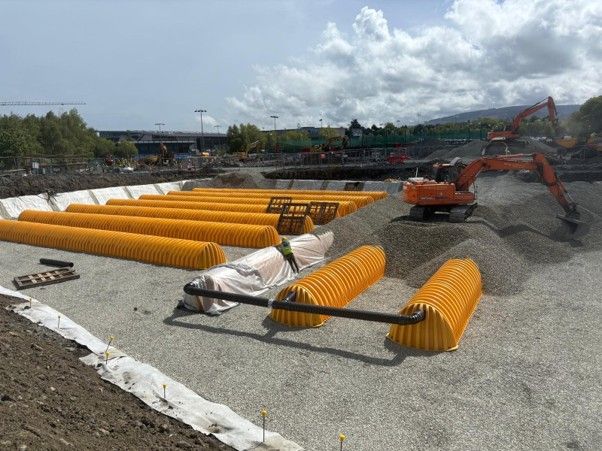
A landmark synthetic turf project at University College Dublin (UCD) has enabled sports pitches to capture and store rainfall for use across the site, including irrigating the natural grass pitches alongside them.
The project began in February 2025 and remains ongoing, forming part of a broader expansion of UCD's sports facilities, including creating a modern indoor sports hall.
Accommodating the new hall meant relocating UCD’s existing synthetic turf pitches, which in turn presented the opportunity for a full reset and upgrade of the playing surfaces.
Water management was central to the design from the outset. UCD's Belfield campus was originally a site of extensive green space, but decades of growth have added numerous buildings to house its expanding facilities.
Run-off from those rooves and hard surfaces needed managing, and the new pitches provide a solution that can do exactly this while still offering a high-quality playing surface.
A series of attenuation tanks were designed and installed beneath the pitches, with capacity to hold the large volume of water draining through the synthetic surface. The tanks were set within a permeable aggregate matrix, adding further temporary attenuation as water percolates through the pitches. Stormtech tanks and pipework were installed by CubicM3 | Microstrain Ltd, with Tony Patterson Sportsgrounds delivering the pitch works.
Ground conditions presented the main obstacle. The pitches sit on very poor ground, and considerable improvement works were required before the tank foundations could be laid and the pitches built over them.
Daniel McGeever, Project Engineer – University College Dublin, said: "The pitches have provided our students and the wider community with high-quality synthetic turf surfaces to play on, which was always the primary aim. What the water management solution adds is a secondary benefit alongside that. We have avoided discharging into the local authority drainage system because the run-off is successfully attenuated on site, and that stored water is a genuine resource for us."
Synthetic turf pitches have a lifecycle measured in decades, typically 10-12 years, and the water management system designed into the build will function across that entire period. Over the extended timescale, the financial return on this approach can be significant.
Stefan Diderich, Director General/CEO at EMEA Synthetic Turf Council (ESTC), said: "What makes this project stand out is how much a single piece of infrastructure is able to deliver. The synthetic turf pitches provide the playing capacity a growing university needs, while at the same time helping the campus manage its water sustainably.
"It is a great example of synthetic and natural surfaces working together rather than in isolation, with water captured beneath one supporting the other. As regulation around surface water tightens across Europe, we expect more estates managers to look at what their facilities can contribute beyond sport."
Find out more about water management with synthetic turf at https://estc.info/synthetic-turf-benefits/water-management/